25 minutes of work, 5 minutes of break — then repeat. The Pomodoro Technique is one of the most effective and easiest time management methods to put into practice. Here's how to use it, which tools to choose, and why consistency is the real key.
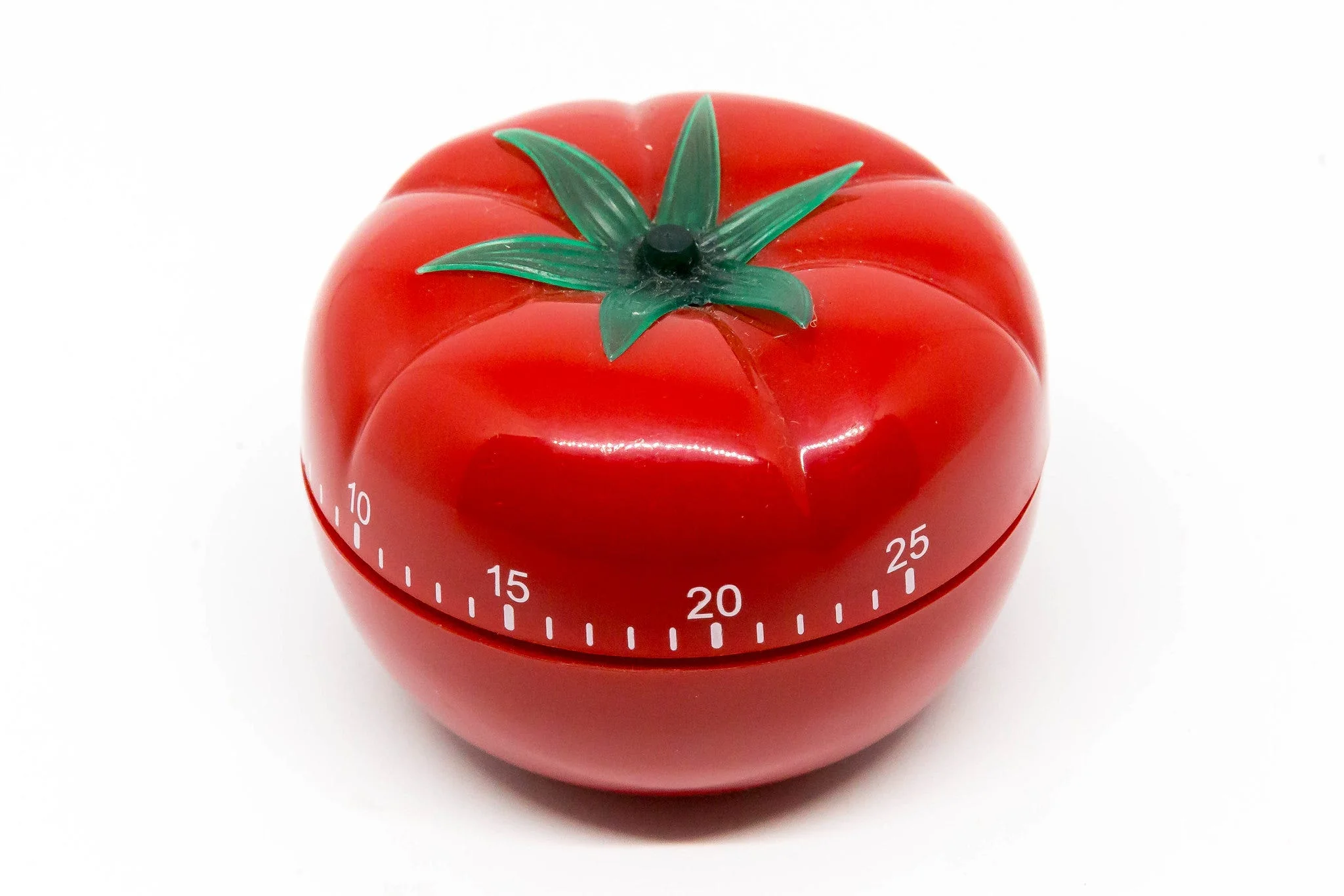
The Pomodoro Technique was developed by Francesco Cirillo in the late 1980s while he was a university student. Struggling to focus, he reached for the tomato-shaped kitchen timer (pomodoro in Italian) sitting on his counter — and devised the method that bears its name. Forty years on, it remains one of the most effective approaches to fighting procrastination and interruptions.
The five-step process
- Choose a specific task to work on
- Set a timer for 25 minutes
- Work without interruption until the alarm sounds
- Take a short 5-minute break (stand up, stretch, hydrate)
- After 3 or 4 cycles, take a long break of 20 to 25 minutes
Each 25-minute interval is called a pomodoro. The unit is intentionally short: it makes intimidating tasks manageable, and forces you to define what you're doing right now rather than procrastinating on a vague project.
 The Pomodoro loop: 25 min of focused work, 5 min break, then start again.
Tools — from simplest to most integrated
Cirillo's original tool was a mechanical timer. It's still an excellent option today: the physical act of winding up the timer signals the start of a session in a way that clicking an app button can't quite replicate. A basic kitchen timer or your phone's Clock app works perfectly — without parasitic notifications.
For those looking for a more integrated experience:
- PomoDone — syncs with Trello, Asana, Todoist and other task managers. Available on App Store and Google Play. Ideal for teams wanting to link time to tickets.
- Focus — Pomodoro Time Tracker (iOS) — clean interface, session statistics, discreet alarm sound. Very popular among developers.
- Your phone's native stopwatch or a smartwatch — minimalist, frictionless, distraction-free.
The focus totem in open-plan offices
In open-plan offices, one of the Pomodoro method's main challenges is protecting your 25 minutes from colleagues' interruptions. A question asked at the wrong moment breaks concentration and costs an average of 15 to 23 minutes to regain the same level of focus.
Some teams have adopted the focus totem principle: an object placed visibly on the desk — a small lit lamp, a flag, a distinctive item — that visually signals to the team: "I'm in a session, please don't interrupt me." A non-urgent question? It waits until the next break.
This totem is a better alternative to headphones-over-ears, which provides complete isolation but also cuts off necessary exchanges. The totem says "focused" without saying "inaccessible" — it invites colleagues to come back in 15 minutes rather than interrupting or being completely ignored.
Why consistency is the real key
The Pomodoro Technique is simple. Its difficulty isn't in understanding it, but in practising it consistently. In the first few days, 25 minutes can feel either very short (you're in the zone) or very long (you can't concentrate). That's normal.
Consistency builds conditioning: the brain learns to associate starting the timer with a state of concentration. After a few weeks of daily practice, entering the flow state becomes faster and more reliable. It's the same principle as sporting routines: effectiveness comes from repetition, not just intention.
Practical tip: start with 3 pomodoros per day on your most important tasks, before checking emails or Slack. Within a few weeks, you'll have accomplished more high-value work than in the previous months.